

SIPOC: Mapeo de Procesos de Alto Nivel

- Supplier (Proveedor): ¿Quién provee las entradas al proceso?. Puede tratarse de un proveedor externo o, simplemente, el proceso anterior.
- Input (Entrada): ¿Qué precisa el proceso? Es todo lo que utiliza el proceso para desarrollarse. Puede tratarse de información, material o documentación.
- Process (Proceso): ¿Cuáles son las actividades que se realizan sobre las entradas, que añaden valor y las convierten en salidas?.
- Output (Salida): ¿Qué entrega el proceso? Dependiendo del caso, puede ser un producto, información o documentación, entre otras posibilidades.
- Customer (Cliente): ¿Quién precisa las salidas del proceso? En este caso también puede ser un cliente externo, o el proceso siguiente.
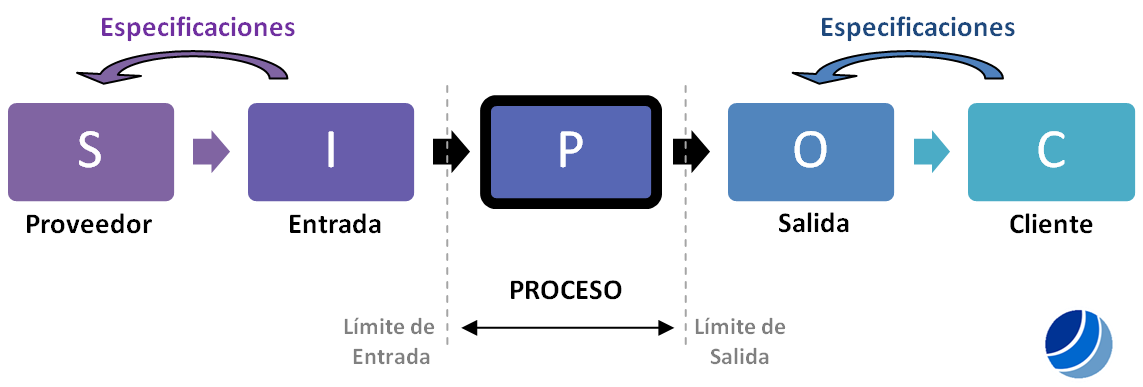

SIPOC resulta una herramienta de suma utilidad cuando hay que describir un proceso de una forma sintética y clara. Se puede utilizar, por ejemplo, a la hora de definir los procesos en la implementación de la metodologíaDMAIC en Six Sigma, o en cualquier proyecto de mejora o evento kaizen
In previous publications we talked about the importance of having all the necessary information for a certain analysis in a single place. The possibility of having everything we need within sight gives us an integral idea of the matter, forcing us to be synthetic and concrete.
There are several ways to describe a process, to represent it or «map it». One of the most used is the so-called SIPOC. This acronym comes from the initial letters in English of the main components of any process (whatever it is):
Supplier (Provider): Who provides the inputs to the process? It can be an external provider or, simply, the previous process.
Input (Input): What does the process require? It is all that the process uses to develop. It can be information, material or documentation.
Process: What are the activities that are carried out on the inputs, which add value and turn them into outputs ?.
Output: What does the process deliver? Depending on the case, it can be a product, information or documentation, among other possibilities.
Customer (Client): Who needs the outputs of the process? In this case it can also be an external client, or the next process.
It may sound basic, but it is essential that we define what we are talking about when we are talking about a process. Let’s go to the standard definition that is currently most accepted, at least in the world of quality management: the one provided by ISO 9000: 2015. This standard defines a process as the «set of mutually related activities that use the inputs to provide an expected result». The type of result depends on the context in which we find ourselves, but it can be a product, a service or simply an exit. Generally the processes are concatenated with each other, so the input of a process is the output of the previous process and the output of this is the input of the later. A set of two or more interacting processes can also be considered as a single process.
The goal of SIPOC is to represent in a single diagram the process that is being analyzed taking into account all the mentioned components and answer the questions posed. All the aspects that make up the process should be clear, which allows, among other advantages, defining metrics to evaluate performance and identify the activities that add value. It helps with the identification of waste and the detection of opportunities for improvement and bottlenecks. For these reasons, this technique is widely used during the implementation of methodologies such as Lean or Six Sigma.
As a good visual control tool, all the information can be turned into a single sheet. The most common format is that of a table, in which each component is listed in detail, and in the central column is represented by a flow diagram to the process itself.
SIPOC is a very useful tool when you have to describe a process in a synthetic and clear way. It can be used, for example, when defining the processes in the implementation of the DMAIC methodology in Six Sigma, or in any improvement project or kaizen event.[:]