

Método de los 3 Guen: herramienta de mejora continua
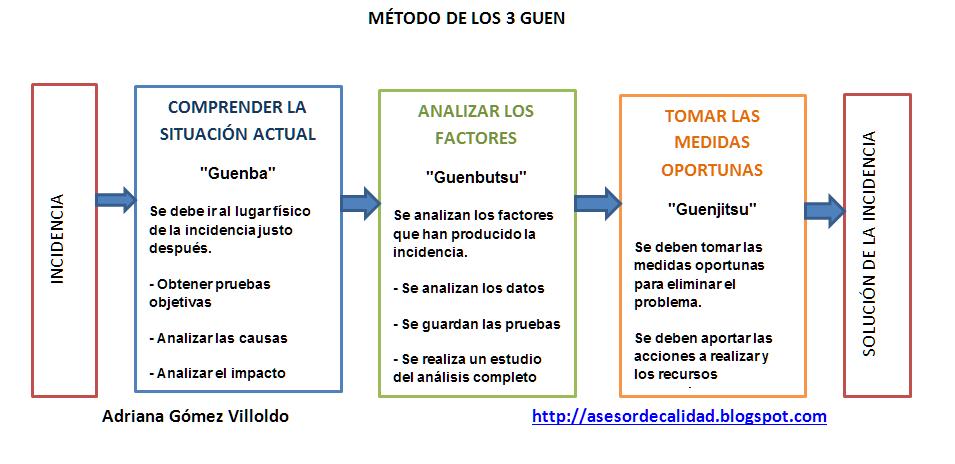
En la siguiente imagen podemos diferenciar estas tres etapas:
¿Qué beneficios nos aporta el aplicar esta metodología?
Si la analizamos bien, nos recuerda al ciclo de mejora continua de Deming (PDCA), aunque este último desarrolla la metodología un grado más, ya que su forma cíclica nos permite la mejora continua. Por ese motivo, el ciclo de Deming es la base de los requisitos y la metodología que expone la norma ISO 9001:2015.
Ejemplo sencillo
A ver una situación sencilla, es una empresa en la que el cliente está realizando una reclamación telefónica a una administrativa, esta inmediatamente informa al responsable del problema. El responsable intenta recopilar toda la información necesaria con los datos facilitados por el cliente y otras pruebas, analiza qué ha sucedido y el porqué, y le da una solución rápida.
Como podéis ver, para incidencias fáciles es útil esta técnica, pero si se requiere de hacer un análisis profundo y eliminar de raíz la causa principal, para que no se vuelva a producir, se deben utilizar otras herramientas.
In this article I want to show you a Japanese methodology, which has served as a basis to develop others currently applied in modern quality. It is a very simple methodology, and requires other quality tools to be really effective. Therefore, I will explain to you what is it? How does it apply? What steps should be followed? What are the benefits of applying this methodology? What are the disadvantages of this methodology?
What does it consist of?
The Guen method is a quality tool, developed in Japan and whose objective is the elimination of a problem or incidence from the understanding and objective analysis of the root cause that has triggered the incidence.
How does it apply? What steps should be followed?
This methodology is divided into three steps or phases of work:
1. Understand the current situation – Work site («Guenba»): it is the first of the stages and seeks to understand the current situation through which the organization passes.
The essential points in the first phase are:
– See the location of the incident.
– Do not count on other opinions but see it with your own eyes.
– Not only to have information but to make a collection of data and take photos of the facts.
– We must analyze the impact of the incident and see its impact, all of them in the shortest possible time since the accident happens.
2. Analyze the factors – Purpose of the analysis («Guenbutsu»)
The objective is to analyze the factors that have caused the incident situation, for this:
– Carefully observed and analyzed data.
– It talks to all the people involved, without prejudice, and in an objective way, without making value judgments.
– Evidence of the incident is kept.
– A thorough study of the incident and the system surrounding it is done.
3- Take appropriate measures – Real situation («Guenjitsu»)
The solution to the problem must be sought.
At this stage you should do:
– A realistic and possible solution to the problem must be applied.
– Limit actions to solve the problem.
In the following image we can differentiate these three stages:
What are the benefits of applying this methodology?
It is a tool that with a pimp of costs and time seeks to solve a problem efficiently, analyzing objectively and without rambling, getting information in situ from various perspectives to achieve effective corrective action.
If we analyze it well, it reminds us of the cycle of continuous improvement of Deming (PDCA), although the latter develops the methodology one more degree, since its cyclical form allows us continuous improvement. For this reason, the Deming cycle is the basis of the requirements and methodology set forth in ISO 9001: 2015.
What are the disadvantages of this methodology?
– Most of the time, if the person who analyzes and obtains the evidence is a worker, who is involved in the same process, or has close contact with the other workers involved, it is not possible to maintain objectivity, and the Analysis can lead to errors, and consequently makes it impossible to eliminate the problem.
– For the collection and analysis of data, it is necessary to use other tools that allow us to make the necessary decisions to solve the problem, among which we can mention the seven quality tools, the 5 reasons, etc.
Simple example
You do not need to show an example because of its simplicity, since when an incident or problem arises, the team or the responsible person is presented physically where it has occurred, collects tests and data, analyzes them and takes the actions that are suitable to solve it.
To see a simple situation, is a company in which the client is making a telephone complaint to an administrative, this immediately informs the person in charge of the problem. The manager tries to gather all the necessary information with the data provided by the client and other tests, analyzes what has happened and why, and gives a quick solution.
As you can see, for easy incidents this technique is useful, but if it is necessary to do a deep analysis and root out the main cause, so that it does not happen again, other tools must be used.[:]