[:es]

Las claves del Sistema de Producción Toyota (TPS): Las 4P y los 14 Principios.
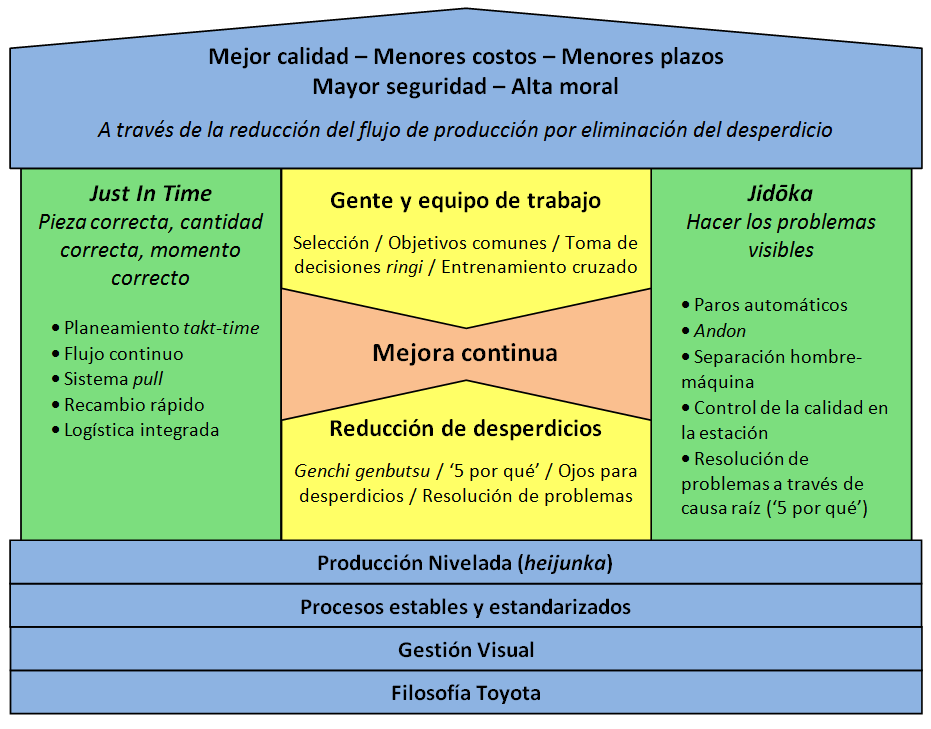
Estructura del Sistema de Producción Toyota
FUENTE: ‘The Toyota Way’ – Jeffrey Liker (2004)
El Dr. Jeffrey Liker, profesor de ingeniería industrial de la Universidad de Michigan, es el autor de ‘The Toyota Way‘ (2004), un excelente compendio que destaca los principios que hicieron del Sistema de Producción Toyota(TPS – Toyota Production System – トヨタ生産方式) un modelo a seguir.
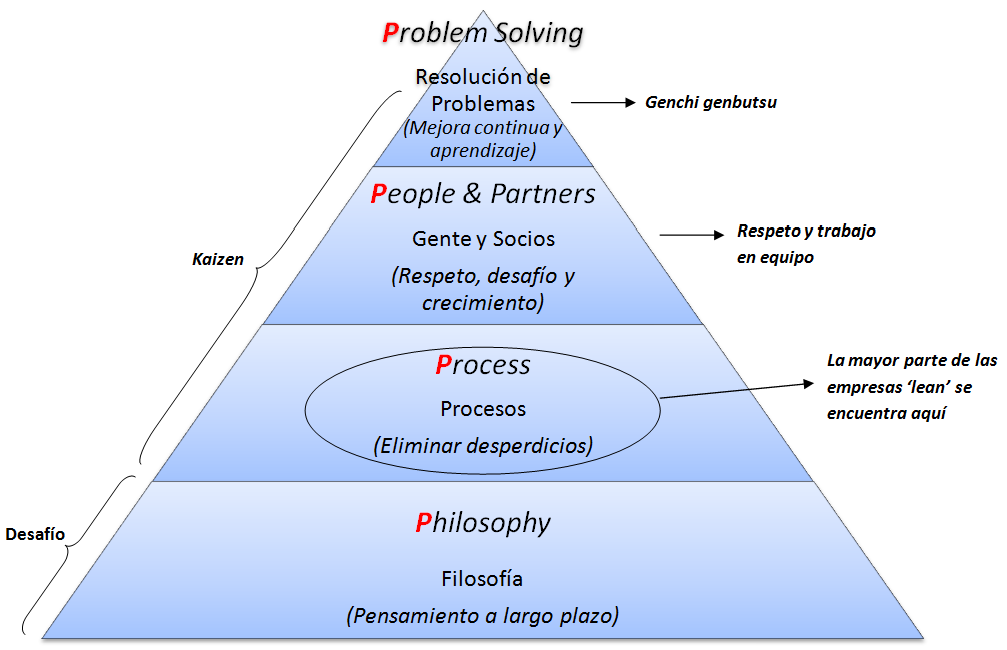
¿Qué lo diferencia de los demás sistemas de producción? ¿Por qué llegó a ser tan exitoso? Analizando estos 14 Principios uno puede comenzar a responder estas preguntas. Para facilitar su comprensión, el autor dividió estos principios en cuatro categorías a las que denominó las ‘4P‘ porque cada una de ellas comienza con P en idioma inglés: Filosofía (Philosophy), Proceso (Process), Gente y Socios (People and Partners) y Resolución de Problemas (Problem Solving). El modelo de las 4P de Liker se representa gráficamente mediante una pirámide con base en la Filosofía y ascendiente hasta la Resolución de Problemas. Desarrollaremos cada categoría, detallando cada uno de los principios incluidos.
Modelo de las 4P de Toyota
FUENTE: ‘The Toyota Way’ – Jeffrey Liker (2004)

(I) Filosofía a largo plazo.

Como estamos acostumbrados, todo sistema o concepto de origen japonés constituye no sólo un modo de trabajar, de hacer las cosas, sino que tiene base en una filosofía, en un modo de pensar y ver las cosas. Una manera de vivir alineada con principios arraigados. Como filosofía oriental, TPS basa sus decisiones en el largo plazo, sin buscar resultados inmediatos y efímeros. Toda la organización debe estar alineada con la filosofía, y entender que no se busca únicamente el lucro.
Principio # 1: Basar decisiones de la dirección en filosofía de largo plazo, aún a expensas de metas financieras de corto plazo.

(II) El proceso correcto producirá los resultados correctos.

Esta categoría se centra en los principios fundamentales que rigen el funcionamiento del pensamiento Just In Time (JIT). Contempla los principios que tienen que ver con lo operativo y estratégico del sistema.
Principio # 2: Crear un flujo de proceso continuo que lleve los procesos a la superficie.
Principio # 3: Usar sistemas pull para evitar la sobreproducción.
Principio # 4: Elevar la carga de trabajo (heijunka): ‘Trabaje como una tortuga, no como liebre‘.
Principio # 5: Construir una cultura de detener los problemas fijos, para conseguir la calidad correcta la primera vez.
Principio # 6: Las tareas estandarizadas son fundamentales para la mejora continua y el empoderamiento del empleado.
 
Principio # 7: Usar el control visual para los problemas no se escondan.
Principio # 8: Usar sólo tecnología confiable, testeada exhaustivamente que sirva a los procesos y la gente.

(III) Agregar valor a la organización desarrollando a su gente y socios.

Los socios y proveedores conforman una red de mutua colaboración. Son propiamente una extensión del propio negocio. El grado de participación en los cambios y las mejoras es fundamental.
Principio # 9: Generar líderes que entiendan profundamente el trabajo, vivan la filosofía y enseñen esto a otros.
Principio # 10: Desarrollar gente excepcional y grupos que sigan la filosofía de su compañía.
Principio # 11: Respetar la red extendida de socios y proveedores, desafiándolos y ayudándolos a mejorar.

(IV) Solucionar continuamente los problemas lleva al aprendizaje organizacional.
Toyota posee un sistema muy particular de gestión del conocimiento, el cual será desarrollado con mayor detalle en otras publicaciones: el concepto de genchi genbutsu, que involucra a la gente en el análisis de un problema invitándola a ver las cosas por sí misma, personalmente en el lugar real de ocurrencia. Esto evita subjetividades propias de la abstracción o de basarse en opiniones o comentarios de un tercero. También se considera la importancia de nemawashi, como un método sumamente innovador de toma de decisiones basado en el consenso. Por último, dos conceptos ancestrales, que son la esencia de los sistemas de producción japoneses: la búsqueda de la mejora continua, el kaizen, y la auto-reflexión y el reconocimiento y aprendizaje de los errores: el hansei.
 
Principio # 12: Ir y ver por uno mismo para entender profundamente la situación (genchi genbutsu).
Principio # 13: Tomar decisiones lentamente, por consenso y considerando todas las opciones detalladamente, e implementar decisiones rápidamente (nemawashi).
Principio # 14: Convertirse en una organización que aprende a través de reflexiones constantes (hansei) y mejora continua (kaizen).
 .
[:en]The keys to the Toyota Production System (TPS): The 4P and the 14 Principles

Structure of the Toyota Production System
SOURCE: ‘The Toyota Way’ – Jeffrey Liker (2004)
Jeffrey Liker Dr., professor of industrial engineering at the University of Michigan, is the author of ‘The Toyota Way’ (2004), an excellent compendium highlighting the principles that made Toyota Production System (TPS – Toyota Production System -ト ヨ タ 生産 方式) a role model.

What sets it apart from other production systems? Why it became so successful? Analyzing these 14 Principles one can begin to answer these questions. To facilitate understanding, the author divided these principles into four categories that he called the ‘4P’ because each begins with P in English: Philosophy (Philosophy), process (Process), People and Partners (People and Partners ) and Problem Solving (Problem Solving). The model of the 4P Liker is represented graphically by a pyramid based on the philosophy and ascending to Problem Solving. We develop each category, detailing each of the principles included.

TPS
4P model Toyota
SOURCE: ‘The Toyota Way’ – Jeffrey Liker (2004)

(I) Philosophy long term.

As we are used, any system or concept of Japanese origin is not only a way of working, of doing things, but it is based on a philosophy, a way of thinking and seeing things. A way of living aligned with established principles. As oriental philosophy, TPS bases its decisions on the long term, without seeking immediate and ephemeral results. The entire organization must be aligned with the philosophy, and understand that not only seeks profit.

Principle # 1: To base management decisions on long-term philosophy, even at the expense of short-term financial goals.

(II) The right process will produce the right results.

This category focuses on the fundamental principles governing the functioning of thought Just In Time (JIT). Contemplate the principles that have to do with the operational and strategic system.

Principle # 2: Create a continuous flow process leading to the surface processes.

Principle # 3: Use pull systems to avoid overproduction.

Principle # 4: Raise the workload (heijunka): ‘Work like a turtle, not as hare’.

Principle # 5: Build a culture of stopping the fixed problems, to get quality right the first time.

Principle # 6: Standardized tasks are essential for continuous improvement and employee empowerment.

Principle # 7: Use visual check for problems not hide.

Principle # 8: Use only reliable technology, tested extensively to serve the processes and people.
(III) Add value to the organization by developing your people and partners.

Partners and suppliers form a network of mutual collaboration. They are really an extension of the business. The degree of participation in the changes and improvements is essential.

Principle # 9: Generate leaders who deeply understand the work, live the philosophy and teach it to others.

Principle # 10: Develop exceptional people and groups that follow the philosophy of your company.

Principle # 11: Respect your extended network of partners and suppliers by challenging them and helping them improve.

Piramide4P
(IV) Troubleshooting problems continually leads to organizational learning.

Toyota has a very particular system of knowledge management, which will be developed in more detail in other publications: the concept of genchi Genbutsu, involving people in analyzing a problem inviting her to see things for herself, personally the actual place of occurrence. This prevents own abstraction or based on opinions or comments of a third subjectivities. It is also considered the importance of nemawashi, as a highly innovative method of decision-making based on consensus. Finally, two ancient concepts, which are the essence of Japanese production systems: the pursuit of continuous improvement, kaizen, and self-reflection and recognition and learning from mistakes: the hansei.

Principle # 12: Go and see for yourself to thoroughly understand the situation (Genchi genbutsu).

Principle # 13: Make decisions slowly by consensus and considering all options in detail, and implement decisions quickly (nemawashi).

Principle # 14: Become a learning organization through constant reflections (hansei) and continuous improvement (kaizen) organization.[:]

[:es]Las claves del Sistema de Producción Toyota (TPS): Las 4P y los 14 Principios.[:en]The keys to the Toyota Production System (TPS): The 4P and the 14 Principles[:]

Uso de cookies

Este sitio web utiliza cookies para que usted tenga la mejor experiencia de usuario. Si continúa navegando está dando su consentimiento para la aceptación de las mencionadas cookies y la aceptación de nuestra política de cookies, pinche el enlace para mayor información.

ACEPTAR
Aviso de cookies