


-
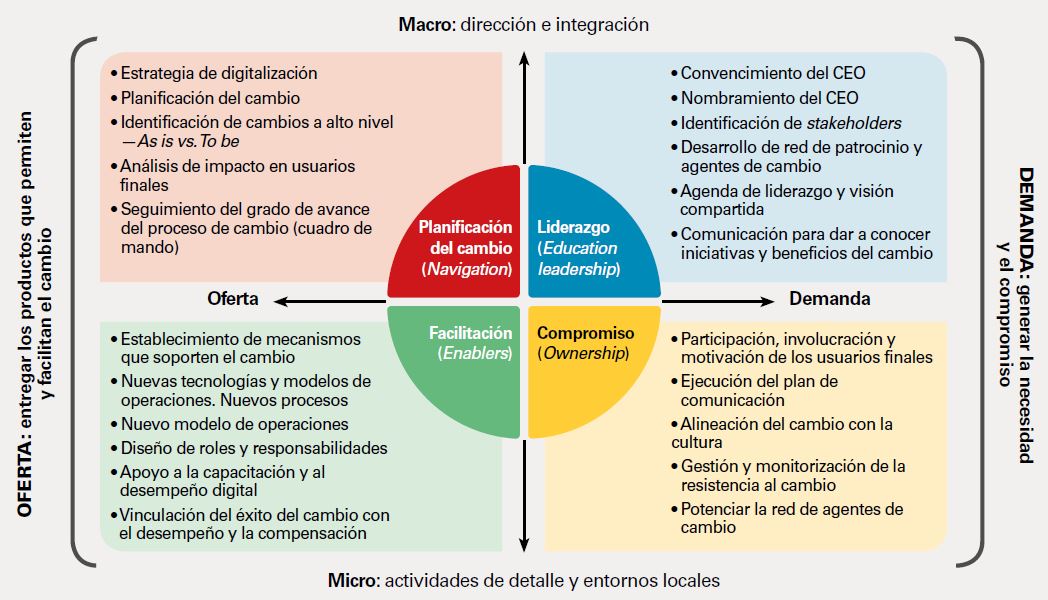
Liderazgo (macro-demanda): El líder del cambio debe saber definir las líneas estratégicas básicas del proceso, desarrollar una buen red de afiliaciones al proyecto y comunicar muy bien lo necesario del mismo.
-
Compromiso (micro-demanda): alinear el cambio con la cultura de la organización, identificar y monitorizar las resistencias y potenciar la red de agentes de cambio.
-
Facilitación (micro-oferta): Poner sobre la mesa los recursos necesarios, los nuevos modelos operativos, diseñar nuevos roles y nuevas responsabilidades, promover la capacitación y vincular el éxito del cambio con el desempeño y la compensación.
-
Planificación (macro-oferta): Planificar las fases del cambio, diseñar éxitos a corto plazo que generen confianza en el proceso, cuadro de mando,…

At the same time, we must know how to analyze and communicate well what is labeled in the chart as ‘demand’, that is, explaining and explaining why it is important to make this change and what advantages it will give us without forgetting to credit the ‘offer’. to say, the elements and resources with which we count to carry out the transit.
With this double axis we end up obtaining a matrix two by two, those that so much like theorists and consultants, that synthesizes the complex reality of the change in four functions or basic activities:
- Leadership (macro-demand): The leader of the change must know how to define the basic strategic lines of the process, develop a good network of affiliations to the project and communicate very well what is necessary.
- Commitment (micro-demand): align the change with the culture of the organization, identify and monitor the resistances and enhance the network of agents of change.
- Facilitation (micro-offer): Putting in the table the necessary resources, the new operational models, designing new roles and new responsibilities, promoting training and linking the success of change with performance and compensation.
- Planning (macro-offer): Plan the phases of change, design short-term successes that generate confidence in the process, scorecard, …
It is advisable to attend to this matrix when designing or directing a process of change and become aware of whether we have had or are taking into account all these elements or facets or if, on the contrary, we have forgotten something[:]