
Recientemente, en una sesión de formación LEAN a los operarios de una empresa, les estaba explicando la metodología de las 5s proyectando una foto de una línea de montaje que, dado su perfecto estado de orden y limpieza, parecía otra cosa y no una fábrica. Como se suele decir, “se podía comer en el suelo”. Uno de los participantes interrumpió para decir: “Yo no tengo tiempo para mantener limpio mi puesto de trabajo”. Le pregunté: “¿Piensa usted que a los operarios de la foto les sobra el tiempo? ¿O quizás sea precisamente por eso, porque no tienen tiempo que perder, por lo que mantienen así de limpio y ordenado su puesto?”.
En ocasiones nos encontramos con espacios físicos de trabajo muy saturados, en donde conviven, por ejemplo, equipos, archivos de documentos, estanterías con material obsoleto o que se utiliza poco, con gran cantidad de materiales, herramientas, productos en proceso o materias primas.
La falta de clasificación, orden y limpieza ocasiona pérdidas de eficacia. ¿Se imagina alguien al equipo de mecánicos que interviene en las paradas de la Fórmula 1 consiguiendo esos reducidos tiempos de cambio sin un orden perfecto y sin un espacio de trabajo limpio?
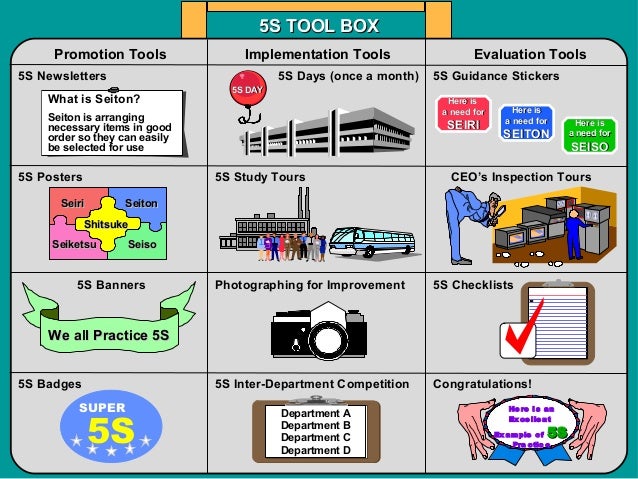
La metodología de las 5s es una sencilla técnica ideada para mantener el puesto de trabajo organizado, limpio y seguro y, como consecuencia, eficiente. Su nombre se debe a la letra por la que empieza, en japonés, cada una de las 5 disciplinas que contempla:

|
SEIRI (separar) |
Identificar y separar los materiales estrictamente necesarios para cada operación, y retirar del puesto de trabajo los no necesarios. Se clasifican los que se pueden utilizar en función de su frecuencia de uso, según sea diaria, semanal o mensual. |
|
SEITON (organizar) |
Colocar los equipos y materiales según el sentido del flujo de trabajo, de forma que sean intuitiva y fácilmente localizables. De este modo se eliminan pérdidas por movimientos, búsquedas, esperas o transportes. |
|
SEISO (limpieza) |
Identificar y eliminar las fuentes de suciedad, y establecer los métodos, materiales, frecuencias y niveles de limpieza. La limpieza ayuda en la prevención de accidentes y a crear un puesto de trabajo ergonómico donde la persona se encuentre más a gusto. |
|
SEIKETSU (estandarizar) |
Estandarizar las actuaciones para mantener el puesto de trabajo limpio y ordenado, preferiblemente mediante control visual. Establecer elementos visuales que permitan distinguir fácilmente y de forma inmediata una situación normal de una anormal, como la ausencia o falta de disponibilidad de un determinado material en el lugar establecido, o la presencia de una anormal cantidad de trabajo, por ejemplo, colas de personas excesivamente largas. |
|
SHITSUKE (disciplina y hábito) |
Establecer normas para mantener y verificar periódicamente el nivel de orden. Dotar a los equipos de los recursos necesarios para que se pueda mantener la organización de los puestos de trabajo. |
La Gestión Visual de un proceso o de un puesto de trabajo pretende que cualquier persona pueda interpretar rápidamente el estado en el que se encuentra el trabajo, o el puesto, respecto a lo planificado (áreas más cargadas, procesos más cargados, estado de los trabajos en curso,…). La gestión visual implica:
- Eliminar lo que no se necesita.
- Clasificar y ordenar: un sitio para cada cosa y cada cosa en su sitio.
- Puestos de trabajo limpios y con estándares de limpieza claros y definidos.
- Estados de los procesos visibles de una forma rápida y sencilla.
- Situaciones fuera de lo previsto rápidamente identificadas y gestionadas.
- Eficiencia y progreso también visibles rápidamente.
- Entorno de trabajo seguro.
La gestión visual se consigue con sistemas de colores, señales verticales y horizontales, tableros informativos, luces, etc. Por ejemplo, los sistemas Andon indican mediante luces de colores el estado de los equipos y procesos de fabricación. Los Andon ayudan a los profesionales proporcionándoles rápidamente la información que necesitan para gestionar el proceso.
La gestión visual en un puesto de trabajo debe permitir:
- Distinguir rápidamente entre lo que es normal y lo que no lo es.
- Disponer de señales de niveles mostrando el mínimo y/o el máximo de los materiales en los puestos de trabajo y en los almacenes.
- Disponer de estanterías ergonómicas para materiales y equipos muy usados.
- Señalar el perímetro de almacenaje destinado para las herramientas y materiales.
- Identificar áreas de material defectuoso.
- Disponer los procedimientos del proceso en los puestos de trabajo.
La característica común de los puestos de trabajo de las organizaciones que planifican y gestionan los trabajos en lotes, ya sea una fábrica o una empresa de servicios (lotes de productos, lotes de expedientes, lotes de proyectos,…), es la existencia de significativas cantidades de material en el puesto, en ocasiones con falta de clasificación y con ausencia de orden y limpieza.
Por el contrario, en un entorno de producción “lean” o de prestación de servicios de forma ajustada, los materiales y herramientas están identificados y los espacios marcados para señalar el lugar dispuesto para cada cosa. El profesional dispone de la información necesaria para gestionar su trabajo, debiendo avisar al jefe de su equipo en el caso de necesitar ayuda, o de haber identificado defectos críticos que estén más allá de su capacidad de autocontrol, evitando que el producto pase a la siguiente etapa del proceso y corrigiendo la situación lo antes posible.
Una imagen vale más que mil palabras. La Gestión Visual
Seguimos nuestra serie de artículos con un tema que se relaciona bastante con las 5S tratadas anteriormente. Este mes hablaremos de la Gestión Visual, otra herramienta Lean, que ayuda a trabajar de forma estandarizada y a simplificar la gestión de los procesos y los flujos de información asociados.
La gestión visual o visual management se define como un sistema donde las informaciones necesarias para la gestión operativa se distribuyen entre las personas interesadas utilizando, sobretodo, formatos visuales.
Esto ayuda a promover la participación en la mejora de las actividades a todas las personas involucradas (responsables y personal operativo), dando información que facilite la toma de decisiones y las acciones rápidas y eficaces, con el objetivo de resolver “anomalías’” y estimular la prevención de problemas.

Si nos centramos en cualquier proceso o cualquier trabajo que hacemos, la gestión visual permite conocer a primera vista lo que realmente está sucediendo y lo que debería estar sucediendo, de forma que cualquier error se haga perfectamente visible, detectándose los problemas en su fase inicial. Si no puedes ver tus problemas, no puedes resolverlos.
Por lo tanto, los sistemas de gestión visual hacen que la información llegue a todo el mundo, tanto directivos como operadores, de forma ágil y efectiva, facilitando la comunicación y el intercambio para mejores prácticas. De esta manera cualquier persona que entre en un área de trabajo sabe cuáles son sus procesos, el estado de las actividades y su progresión.
La gestión visual puede ser utilizada para comunicar y compartir cualquier información necesaria para el cumplimiento y mejora de los estándares operativos, tales como:
- Estándares de los ciclos de trabajo de las actividades que se dan en el área: instrucciones visuales, códigos de colores / ubicaciones, One Point Lesson (OPL)…
- Gestión de las máquinas e instalaciones: tableros para las actividades de mantenimiento programado, ficha de registro de las anomalías detectadas, check list de control de las instalaciones…
- Actividades de mejora: buzón para recogida de propuestas y sugerencias, tablones para las ideas implementadas, áreas delimitadas para reuniones de sección.
- Indicadores de proceso: gráficos indicadores de objetivos, resultados y diferencias
En el caso de los indicadores de gestión visual, hay que establecer unos pasos previos a su desarrollo:
- Decidir el tipo de proceso que se quiere controlar
- Determinar quién necesita esta información
- Determinar las mejoras que se quieren realizar
- Determinar el sistema de control visual
La gestión visual es aplicable a cualquier organización y nivel de la misma, cuyo objetivo y utilidad básica es diagnosticar y controlar adecuadamente un proceso, ya que ayuda a comunicar mejor y, por tanto, a trabajar con una mayor eficiencia.
En definitiva, ¿qué se pretende conseguir con la gestión visual?:

- Indicar al trabajador sus objetivos en cada momento, teniendo en cuenta la actividad realizada en el pasado y la capacidad futura.
- Eliminar el traspaso de información individualizado involucrando a todas las personas relacionadas con dicho proceso.
- Detectar anomalías en productos, servicios, equipo y procesos a simple vista.
- Que el estándar sea claro y esté a la vista.
- Reaccionar con rapidez ante los problemas y saber qué medidas correctivas llevar a cabo para resolver los problemas.
¿Cuáles son los beneficios de su implantación?
- Aumentar la participación y promover el trabajo en equipo
- Mejorar los procesos
- Entregar productos/servicios más fiables
- Mantener un lugar de trabajo más seguro
- Crear un entorno de trabajo estandarizado
- Mejorar la transparencia, la productividad y la eficiencia de las organizaciones.
Os dejo un interesante TED talk de Tom Wujec, diseñador de información, que se ocupa de explicar la relación entre la creación de significado en nuestro cerebro a partir de la forma en que visualizamos el mundo y cómo podemos mejorar este proceso para resolver algunos problemas.
https://www.youtube.com/watch?v=wPFA8n7goio[:en]If our work environment is disorganized and dirty, it decreases our quality, productivity and the good predisposition of the staff towards the activity that we develop. The 5S technique helps to create habits to establish and maintain the organization, order, standardized cleaning and discipline necessary to achieve a more productive, safe and pleasant work environment, where products and services of higher quality are made. In the current market, the growing demand for quality products and services, at competitive prices, is leading companies to optimize their processes, the 5S is a tool that helps them obtain the necessary conditions to connect the operator with the process, through daily management.
Recently, in a LEAN training session for the operators of a company, I was explaining the methodology of the 5s projecting a photo of an assembly line that, given its perfect state of order and cleanliness, seemed something else and not a factory. As they say, «you could eat on the floor.» One of the participants interrupted to say: «I do not have time to keep my job clean». I asked him: «Do you think that the photo workers have too much time? Or maybe it’s precisely because of that, because they do not have time to lose, so they keep their position clean and tidy? «
Sometimes we find very saturated physical work spaces, where, for example, equipment, document files, shelves with obsolete or little used material coexist, with a large amount of materials, tools, products in process or raw materials.
The lack of classification, order and cleanliness leads to efficiency losses. Can anyone imagine the team of mechanics that intervenes in the stops of Formula 1 getting those reduced times of change without a perfect order and without a clean workspace?
The methodology of the 5s is a simple technique designed to keep the workplace organized, clean and safe and, as a result, efficient. Its name is due to the letter by which it begins, in Japanese, each one of the 5 disciplines that it contemplates:
SEIRI
(pull apart)
Identify and separate the materials strictly necessary for each operation, and remove from the job those that are not necessary. Those that can be used are classified according to their frequency of use, depending on whether they are daily, weekly or monthly.
SEITON (organize)
Place equipment and materials according to the direction of the workflow, so that they are intuitive and easily locatable. In this way losses are eliminated by movements, searches, waits or transports.
SEISO (cleaning)
Identify and eliminate sources of dirt, and establish methods, materials, frequencies and cleaning levels. Cleaning helps in the prevention of accidents and to create an ergonomic workplace where the person is more comfortable.
SEIKETSU (standardize)
Standardize the actions to keep the workplace clean and tidy, preferably through visual control. Establish visual elements that allow to easily and immediately distinguish a normal situation from an abnormal one, such as the absence or lack of availability of a certain material in the established place, or the presence of an abnormal amount of work, for example, queues of people excessively long.
SHITSUKE (discipline and habit)
Establish rules to maintain and periodically verify the level of order. Provide the teams with the necessary resources so that the organization of the jobs can be maintained.
The Visual Management of a process or of a work post wants that any person can interpret quickly the state in which the work is, or the position, with respect to the planned thing (more loaded areas, more loaded processes, state of the works in progress,…). Visual management involves:
Eliminate what is not needed.
Sort and order: a site for everything and everything on your site.
Clean workplaces with clear and defined cleaning standards.
State visible processes quickly and easily.
Situations outside of the planned quickly identified and managed.
Efficiency and progress also visible quickly.
Safe work environment.
Visual management is achieved with color systems, vertical and horizontal signs, information boards, lights, etc. For example, the Andon systems indicate by means of colored lights the state of the equipment and manufacturing processes. The Andons help professionals by quickly providing them with the information they need to manage the process.
Visual management in a workplace should allow:
Distinguish quickly between what is normal and what is not.
Have signals of levels showing the minimum and / or the maximum of the materials in the work places and in the warehouses.
Have ergonomic shelves for materials and equipment used.
Indicate the storage perimeter intended for tools and materials.
Identify areas of defective material.
Arrange process procedures in the workplace.
The common characteristic of the jobs of the organizations that plan and manage the work in lots, be it a factory or a service company (lots of products, lots of files, lots of projects, …), is the existence of significant amounts of material in the position, sometimes with lack of classification and lack of order and cleanliness.
On the other hand, in a «lean» production environment or the provision of services in an adjusted manner, the materials and tools are identified and the spaces marked to indicate the place set for each thing. The professional has the necessary information to manage their work, should notify the head of your team in case you need help, or have identified critical defects that are beyond their ability to self-control, preventing the product from passing to the next stage of the process and correcting the situation as soon as possible.
A picture is worth a thousand words. Visual Management
We follow our series of articles with a theme that is quite related to the 5S discussed above. This month we will talk about Visual Management, another Lean tool, which helps to work in a standardized way and to simplify the management of processes and the associated information flows.
Visual management or visual management is defined as a system where the information necessary for operational management is distributed among interested persons using, above all, visual formats.
This helps to promote the participation in the improvement of the activities to all the people involved (responsible and operational personnel), giving information that facilitates the decision making and the fast and effective actions, with the objective of solving «anomalies» and stimulating the prevention of problems.
visual management
If we focus on any process or any work we do, the visual management allows us to know at first glance what is really happening and what should be happening, so that any error becomes perfectly visible, detecting the problems in its initial phase. If you can not see your problems, you can not solve them.
Therefore, visual management systems ensure that information reaches the entire world, both managers and operators, in an agile and effective manner, facilitating communication and exchange for best practices. This way any person who enters a work area knows what their processes are, the state of the activities and their progression.
Visual management can be used to communicate and share any information necessary for compliance and improvement of operational standards, such as:
Standards of the work cycles of the activities that occur in the area: visual instructions, color codes / locations, One Point Lesson (OPL) …
Management of machines and installations: boards for scheduled maintenance activities, record of anomalies detected, check list of facilities control …
Improvement activities: mailbox for collecting proposals and suggestions, boards for ideas implemented, areas defined for section meetings.
Process indicators: indicators graphs of objectives, results and differences
In the case of visual management indicators, it is necessary to establish some steps prior to their development:
Decide the type of process that you want to control
Determine who needs this information
Determine the improvements you want to make
Determine the visual control system
The visual management is applicable to any organization and level of the same, whose objective and basic utility is to diagnose and control a process properly, since it helps to communicate better and, therefore, to work with greater efficiency.
In the case of visual management indicators, it is necessary to establish some steps prior to their development:
Decide the type of process that you want to control
Determine who needs this information
Determine the improvements you want to make
Determine the visual control system
The visual management is applicable to any organization and level of the same, whose objective and basic utility is to diagnose and control a process properly, since it helps to communicate better and, therefore, to work with greater efficiency.
In short, what is intended to achieve with visual management ?:
Indicate the worker’s objectives at all times, taking into account the activity carried out in the past and future capacity.
Eliminate the transfer of individualized information involving all persons related to this process.
Detect anomalies in products, services, equipment and processes at a glance.
That the standard is clear and in sight.
React quickly to problems and know what corrective measures to take to solve problems.
What are the benefits of its implementation?
Increase participation and promote teamwork
Improve processes
Deliver more reliable products / services
Maintain a safer workplace
Create a standardized work environment
Improve the transparency, productivity and efficiency of organizations.
I leave you an interesting TED talk by Tom Wujec, information designer, who deals with explaining the relationship between the creation of meaning in our brain from the way we visualize the world and how we can improve this process to solve some problems.[:]