[:es]
Las claves para una buena definición del contexto pasan por planificar que La organización debe identificar y determinar su contexto interno y externo, así como identificar sus expectativas y oportunidades, desde el punto de vista de los tres sistemas de gestión que nos ocupan en esta artículo. Daré respuesta a las siguientes preguntas: ¿Qué requisitos expone las norma ISO 45001:2018, ISO 9001:2015, ISO 14001.2015 ? ¿Qué tenemos que tener en cuenta? ¿Podemos integrar los tres documentos?
La actualización de las tres normas, permite integrar mejor los diferentes sistemas de gestión. Nos podemos dar cuenta que el mismo requisito ocupa el mismo apartado en cada una de las normas.
¿Qué requisitos expone las norma ISO 45001:2018 ISO 9001:2015, ISO 14001.2015?
Vamos a analizar a continuación, qué especificaciones debemos cumplir en cada una de las tres normas, debemos distinguir las comunes de las específicas:
Según ISO45001:2018 (OSHAS18001)
4.1 comprensión de la organización y de su contexto
La organización debe determinar las cuestiones externas e internas que son pertinentes para su propósito y que afectan a su capacidad para alcanzar los resultados previstos de su sistema de gestión de la SST.
ISO 14001:2015
4.1 comprensión de la organización y de su contexto
La organización debe determinar las cuestiones internas y externas que son pertinentes para su propósito y que afecta a su capacidad para lograr los resultados de su sistema de gestión ambiental. Estas cuestiones incluyen las condiciones ambientales capaces de afectar o de verse afectadas por la organización.
ISO 9001:2015
4.1 Comprensión de la organización y de su contexto
La organización debe determinar las cuestiones externas e internas que son pertinentes para su propósito y su dirección estratégica, y que afectan a su capacidad para lograr los resultados previstos de su sistema de gestión de la calidad. La organización debe realizar el seguimiento y la revisión de la información sobre estas cuestiones externas e internas.
NOTA 1 Las cuestiones pueden incluir factores positivos y negativos o condiciones para su consideración.
NOTA 2 La comprensión del contexto externo puede verse facilitado al considerar cuestiones que surgen de los entornos legal, tecnológico, competitivo, de mercado, cultural, social y económico, ya sea internacional, nacional, regional o local.
NOTA 3 La comprensión del contexto interno puede verse facilitada al considerar cuestiones relativas a los valores, la cultura, los conocimientos y el desempeño de la organización.
¿Qué deberíamos considerar ?
En los tres casos, debemos identificar todos los factores internos y externos que afectan a la organización, analizando cada uno de los aspectos que puedan afectar a la empresa en las diferentes áreas:
– Dirección estratégica y gestión de calidad de la empresa (ISO 9001:2015)
– Gestión ambiental (ISO 14001:2015)
– Gestión en seguridad y salud (ISO 45001:2015
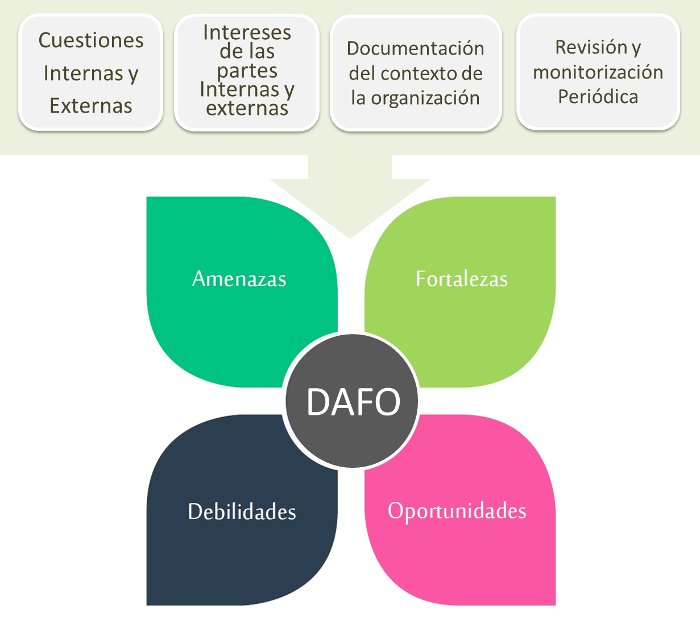
Una de las herramientas que tenemos para poder identificar los factores internos y externos de la organización, es la matriz DAFO.
Si aún y así, tenéis dificultades para identificar factores externos a la organización, que son realmente los que la empresa no puede ejercer y controlar, podéis utilizar también la herramienta PESTEL.
Existe otra herramienta muy utilizada y extendida, que da un paso más allá, a partir de los resultados obtenidos en la matriz DAFO. Esta herramienta se denomina CAME.
Desde mi punto de vista, para simplificar el sistema, creo que es suficiente el uso de la herramienta DAFO. Si se quiere hacer un estudio profundizando más en este requisito, se puede complementar con las otras dos.
¿Podemos integrar los tres documentos?
La respuesta es sí, podemos identificar todos los factores de forma conjunta. En el mismo documento encontraremos algunos factores comunes y específicos a cada uno de los sistemas de gestión. De este modo, se podrá analizar de forma conjunta todos los sistemas de gestión, simplificando los documentos, y dando una visión global de la situación de la empresa.
Qué factores específicos podemos encontrar en los tres sistemas de gestión?
Como sabemos en la matriz DAFO se identifican los factores internos y externos de la organización, separándoos en 4 grupos: Debilidades, Amenazas, Fortalezas y Oportunidades. Os muestro a continuación algunos de los factores específicos (sólo son algunas ideas, existen innumerables factores dependiendo de la empresa):
Gestión en Seguridad y Salud de los Trabajadores: ISO45001 / OSHAS 18001
Debilidades:
Equipamientos obsoletos
Carencia de identificación y evaluación de los riesgos laborales de la actividad
Falta de supervisión del cumplimiento de los procedimientos por parte de los trabajadores
Ambiente y lugar de trabajo poco favorable
Amenazas:
Falta de equipos de protección individual y colectiva
Falta de supervisión y control de los EPI
Alto índice de accidente
Multas y penalizaciones por parte de los organismos oficiales
Investigación de los accidentes por parte de los organismos oficiales
Fortaleza:
Reducción de los incidentes y accidentes laborales
Mejor protección en el trabajo de los trabajadores
Procedimientos estandarizados de seguridad y salud, adaptados a la realidad de los trabajos y a los trabajadores, asimilados y aplicados por los trabajadores de la empresa.
Cooperación de los trabajadores de la empresa
Oportunidades:
Personal capacitado y motivado
Mejora de los procedimientos y metodología en SST que mejores los resultados, y que sean reconocidos por los clientes y trabajadores.
Certificarse en ISO 45001:2018 da un valor añadido respecto a las empresas del sector.
Prioridad de contratación por parte de los clientes.
Los clientes se aseguran que el personal por parte de la empresa que se desplaza a realizar los trabajos en sus instalaciones, cumplirán con los requisitos y procedimientos en cuanto a seguridad y salud que le aplican, ya que están familiarizados e instruidos desde la misma empresa. (Sería un ejemplo de trabajos en obra o en una fábrica).
Todos estos factores pueden ser reflejados en un mismo documento. Cuando diseñéis el formato del documento, dejar bien claro, como os he detallado en este artículo, los que son comunes y específicos, y que aplica a cada sistema y en base a qué normativas. Contra más claro esté, menos dudas puede tener el auditor, y menos incidencias podéis tener.
Tenéis que tener en cuenta, y pensarlo cuando lo elaboréis, que los diferentes factores que identifiquéis, posteriormente se deben tratar o bien como objetivos, o bien evaluar el riesgo de los mismos. Es decir, si identificáis:
– Oportunidades: Deberéis analizar el riesgo de las mismas. Si alguna oportunidad, es realizable a corto plazo y la empresa necesita o quiere ejecutarla, la tendrá que establecer, además, como objetivo.
– Amenazas: Se deberá evaluar el riesgo de las mismas.
– Debilidades: Se deberá evaluar el riesgo de las mismas.
– Fortalezas: en principio no hay que realizar ninguna acción.
Por lo tanto, cuando se apruebe la identificación del contexto de la organización, se deberá realizar un análisis y evaluación de los resultados de las mismas. Este análisis y conclusiones, así como las acciones a tomar, pueden reflejarse en el acta de la Revisión del sistema, que es un requisito común a los tres sistemas de gestión.
Gestión ambiental: ISO14001
Debilidades:
Dificultad en separar los residuos generados.
Deficiencias en la gestión de residuos
Deficiencia de orden y limpieza generando impacto ambiental en las instalaciones de la empresa.
Manejo inadecuado de las aguas residuales
Amenazas:
Aumento del precio en materias primas, con lo que la empresa adquiere de peor calidad y que puede tener un mayor impacto ambiental.
Cambios legislativos que hacen inviable una buena gestión ambiental
Multas económicas por parte de las administraciones por incumplir la legislación ambiental.
Fortaleza:
Generar un entorno saludable.
Oportunidades:
Certificarse en ISO 14001 aumenta las posibilidades de obtener nuevos contratos.
Disminución en el uso de materias primas y energía.
Aumento de la eficiencia ambiental
Reducción de costes a lo largo del tratamiento
Gestión de Calidad: ISO9001
Debilidades:
Ausencia de Calidad
Equipamientos obsoletos
Amenazas:
Nuevos productos que no se conoce la aceptación del cliente.
Deficiencia en los procesos de producción, índice de defectos muy alto.
Falta de control de los costes de producción, generando pérdidas o escasos beneficios.
Mala gestión en el control de la contratación y facturación.
Malas decisiones estratégicas por parte de la Dirección.
Fortaleza:
Conocimiento del mercado
Buena calidad de producto/servicio
Procesos de calidad
Estandarización y optimización de los procesos
Oportunidades:
Automatización de los procesos de la empresa.
Optimización de los recursos.
Mejora en la planificación de los procesos.
[:en]The keys to a good definition of context go through planning that the organization must identify and determine its internal and external context, as well as identify their expectations and opportunities, from the point of view of the three management systems that occupy us in this article. I will answer the following questions: What requirements does ISO 45001: 2018, ISO 9001: 2015, ISO 14001.2015? What do we have to take into account? Can we integrate the three documents?
The updating of the three standards allows better integration of the different management systems. We can realize that the same requirement occupies the same section in each of the rules.
What requirements does ISO 45001: 2018 ISO 9001: 2015, ISO 14001.2015?
We are going to analyze next, what specifications we must fulfill in each one of the three norms, we must distinguish the common ones from the specific ones:
According to ISO45001: 2018 (OSHAS18001)
4.1 understanding of the organization and its context
The organization must determine the external and internal issues that are relevant to its purpose and that affect its ability to achieve the expected results of its OSH management system.
ISO 14001: 2015
4.1 understanding of the organization and its context
The organization must determine the internal and external issues that are relevant to its purpose and that affect its ability to achieve the results of its environmental management system. These issues include environmental conditions that can affect or be affected by the organization.
ISO 9001: 2015
4.1 Understanding of the organization and its context
The organization must determine the external and internal issues that are relevant to its purpose and strategic direction, and that affect its ability to achieve the expected results of its quality management system. The organization must follow up and review the information on these external and internal issues.
NOTE 1 Issues may include positive and negative factors or conditions for their consideration.
NOTE 2 Understanding the external context can be facilitated by considering issues that arise from legal, technological, competitive, market, cultural, social and economic environments, whether international, national, regional or local.
NOTE 3 Understanding the internal context can be facilitated by considering issues related to the values, culture, knowledge and performance of the organization.
What should we consider?
In all three cases, we must identify all internal and external factors that affect the organization, analyzing each of the aspects that may affect the company in the different areas:
– Strategic management and quality management of the company (ISO 9001: 2015)
– Environmental management (ISO 14001: 2015)
– Health and safety management (ISO 45001: 2015
One of the tools we have to identify the internal and external factors of the organization is the SWOT matrix.
If still and so, you have difficulties to identify factors external to the organization, which are really the ones that the company can not exercise and control, you can also use the PESTEL tool.
There is another widely used and extended tool, which goes a step further, from the results obtained in the SWOT matrix. This tool is called CAME.
From my point of view, to simplify the system, I think the use of the SWOT tool is enough. If you want to do a study going deeper into this requirement, you can complement it with the other two.
Can we integrate the three documents?
The answer is yes, we can identify all the factors together. In the same document we will find some common and specific factors to each one of the management systems. In this way, all the management systems can be analyzed together, simplifying the documents, and giving a global vision of the company’s situation.
What specific factors can we find in the three management systems?
As we know in the SWOT matrix, the internal and external factors of the organization are identified, separating them into 4 groups: Weaknesses, Threats, Strengths and Opportunities. I show you some of the specific factors below (only some ideas, there are innumerable factors depending on the company):
Occupational Health and Safety Management: ISO45001 / OSHAS 18001
Weaknesses:
Obsolete equipment
Lack of identification and evaluation of occupational risks of the activity
Lack of supervision of compliance with procedures by workers
Unfavorable work environment and workplace
Threats:
Lack of individual and collective protection equipment
Lack of supervision and control of PPE
High accident rate
Fines and penalties by official bodies
Investigation of accidents by official bodies
Strength:
Reduction of work incidents and accidents
Better protection at work of workers
Standardized safety and health procedures, adapted to the reality of the work and to the workers, assimilated and applied by the workers of the company.
Cooperation of the workers of the company
Opportunities:
Trained and motivated staff
Improvement of the procedures and methodology in SST that improve the results, and that are recognized by the clients and workers.
Certification in ISO 45001: 2018 gives an added value to companies in the sector.
Priority of contracting by customers.
The clients ensure that the personnel on the part of the company that travels to perform the work in their facilities, will comply with the requirements and procedures in terms of safety and health that apply, as they are familiar and instructed from the same company. (It would be an example of works on site or in a factory).
All these factors can be reflected in the same document. When designing the document format, make it very clear, as I have detailed in this article, what are common and specific, and what applies to each system and based on what regulations. The clearer you are, the less doubt the auditor can have, and the fewer incidents you can have.
You have to take into account, and think about it when you elaborate it, that the different factors that you identify must subsequently be treated either as objectives or to evaluate the risk of them. That is, if you identify:
– Opportunities: You should analyze the risk of them. If any opportunity is feasible in the short term and the company needs or wants to execute it, it must also be established as a goal.
– Threats: The risk of them must be evaluated.
– Weaknesses: The risk of them must be evaluated.
– Strengths: in principle no action must be taken.
Therefore, when the identification of the context of the organization is approved, an analysis and evaluation of the results thereof must be carried out. This analysis and conclusions, as well as the actions to be taken, can be reflected in the Minutes of the System Review, which is a common requirement of the three management systems.
Environmental management: ISO14001
Weaknesses:
Difficulty in separating the generated waste.
Deficiencies in waste management
Deficiency of order and cleanliness generating environmental impact in the facilities of the company.
Inadequate handling of wastewater
Threats:
Increase in the price of raw materials, with which the company acquires lower quality and that may have a greater environmental impact.
Legislative changes that make good environmental management unviable
Economic fines by administrations for violating environmental legislation.
Strength:
Generate a healthy environment
Opportunities:
Certification in ISO 14001 increases the chances of obtaining new contracts.
Decrease in the use of raw materials and energy.
Increase in environmental efficiency
Reduction of costs throughout the treatment
Quality Management: ISO9001
Weaknesses:
Absence of Quality
Obsolete equipment
Threats:
New products that the customer acceptance is not known.
Deficiency in production processes, very high defect rate.
Lack of control of production costs, generating losses or few benefits.
Bad management in the control of contracting and billing.
Bad strategic decisions on the part of the Management.
Strength:
Knowledge of the market
Good product / service quality
Quality processes
Standardization and optimization of processes
Opportunities:
Automation of company processes.
Optimization of resources.
Improvement in the planning of the processes.[:]