[:es]
Análisis de campos de fuerza: herramienta de gestión del cambio en la transición a la ISO9001:2015
En el siguiente artículo os presento una herramienta, llamada análisis de campos de fuerza, que nos sirve para gestionar los cambios en la empresa, ya sean pequeños o grandes. ¿En qué consiste? ¿Cuándo se debe utilizar esta herramienta? ¿Para qué tipo de cambios podemos aplicar esta herramienta? Ejemplos de fuerzas impulsoras y restrictivas. Ejemplos de soluciones para disminuir las fuerzas restrictivas. Ejemplo práctico aplicado a una empresa real.
¿En qué consiste?
Esta herramienta nos permite identificar los factores que ayudan o los que detienen el logro del cambio deseado.
Esta herramienta permite apoyar la búsqueda del cambio a través de identificar los factores que impulsan (Fuerzas impulsoras) o los que frenan el cambio (Fuerzas represoras). Una vez que se listan los diferentes valores se analizan, y se determinan soluciones para disminuir las fuerzas represoras, decantando claramente la balanza sobre las fuerzas impulsoras que serán las que nos hagan efectivo el cambio.
Es muy importante, conocer algunas técnicas que nos permitan gestionar mejor los cambios de la empresa, con la finalidad de encontrar un camino que nos facilite la intensa y complicada tarea de incorporar un cambio en la empresa. Otra herramienta que os recomiendo son
los 8 pasos de Kotter.
Los que alguna vez, han tenido la misión de aplicar o participar en algún cambio, aunque sea pequeño en la empresa, se han dado cuenta de lo difícil que es, y el esfuerzo personal que debemos invertir, para convencer y enseñar a los trabajadores, y hacerles partícipe del mismo.
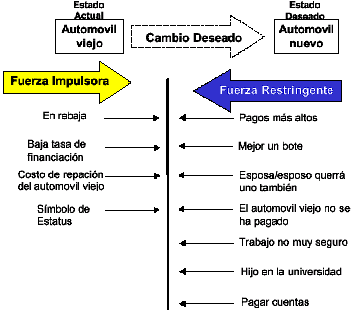
La imagen del Diagrama del análisis del campo de fuerzas tiene la siguiente apariencia:
¿Cuándo se debe utilizar esta herramienta?
– Cuando se desea implementar algo nuevo
– Cuando algo no está funcionando como se esperaba
– Cuando se desee mejorar algo ya existente
¿Para qué tipo de cambios podemos aplicar esta herramienta?
Podemos describir numerosos cambios en que los trabajadores ofrecen resistencia al cambio, como por ejemplo:
– Incorporar un sistema informático para agilizar los procesos (pasar del papel al ordenador es muy costoso)
– Automatizar procesos industriales incorporando nueva maquinaria.
– Mejoras en los procesos
– Mejoras en los procedimientos
– Implantar un sistema de gestión, como por ejemplo la ISO9001:2015, que aplica a todos los procesos de la empresa. Es uno de los grandes problemas que los Responsables de Calidad se encuentran a la hora de realizar su trabajo.
– Cambiar ciertos procedimientos o documentos.
-…
Ejemplos de fuerzas impulsoras y restrictivas
Fuerzas impulsoras:
– Aceptación y aprobación por la Dirección
– Visto de forma positiva por el personal
– Experiencia previa en el cambio, por ejemplo, en un programa informático o maquinaria
– Deseo de aprender nuevos sistemas
– Deseo de mejorar los procesos y los procedimeintos
– Deseo de simplificar y/o automatizar procesos con la finalidad de disminuir la carga de trabajo
– Recursos financieros adecuado
– Recursos de infraestructura adecuados
– Recursos humanos adecuados
– Capacitación y formación continua
– Automatizar la información
– Aumentar la velocidad de producción
– Mejorar el puesto de trabajo
Fuerzas restrictivas
– Visto negativamente por el personal
– Falta de experiencia con los sistemas informáticos, tecnológicos o de maquinaria.
– Experiencias negativas con cambios anteriores
– No querer aprender
– Necesidad de seguir haciendo lo mismo que antes del cambio por comodidad
– Formación inadecuada y rechazo de la misma por los trabajadores
– Miedo a no saber como realizar su trabajo
– Miedo a reproches por parte de los superiores por no saber hacer el trabajo
– Costes elevados que no permitan incorporar los recursos necesarios para asumir el cambio.
– Conflictos Dirección-empleados
– Impaciencia de los empleados. Todo cambio, requiere un tiempo y a veces es a medio o largo plazo, desesperando a los trabajadores por ver efectivo su esfuerzo.
Ejemplos de soluciones para disminuir las fuerzas restrictivas
– Para disminuir la falta de experiencia: la formación, educación y capacitación del personal debe ser continuo y constante para que se adapten sin problemas para que los trabajadores se adapten sin problemas a la nueva forma de trabajar. En los cambios que son tecnológicos o informáticos, con toda seguridad, deberás disponer de una persona cualificada, que esté en contacto con los trabajadores, y hasta que no sepan manipularlo correctamente y con facilidad deberá estar presente y solucionar al instante sus dudas.
– Para disminuir el rechazo aprender: a través de sesiones en grupo o bien de forma individualizada, mostrar la facilidad del manejo del programa y que facilitará su trabajo. Se debe dejar claro desde dirección que el cambio no sirve para sustituir su puesto de trabajo, sino para facilitarle el trabajo.
– Para disminuir el rechazo debido a experiencias negativas pasadas: Para solucionar este punto se debe involucrar en el cambio al personal, en cada fase del cambio, hacer partícipes, solucionar sus dudas de forma fácil y eficaz, y de este modo disminuir su resistencia.
– Para disminuir la competitividad profesional: muchas veces, el rechazo por parte de un trabajador veterano, que normalmente tiene mucho peso en la empresa, es debido a que él se piensa que con el cambio, puede llegar a disminuir su importancia dentro de la empresa, y que las tareas que él realiza serán reemplazadas por otras y eso le cree inseguridad. Para ello, podemos disminuirlo mediante:
a) reconocimiento por parte de la Dirección de DAFO (debilidades, amenazas, fortalezas y oportunidades) de cada uno de los trabajadores.
b) Mesas de trabajo para mejorar el clima laboral
c) Fomentar el trabajo en equipo
d) Fomentar la comunicación efectiva
e) Integrar a todos los miembros en la toma de decisiones
f) establecer distribución de funciones y responsabilidades.
La Dirección debe prestar atención a la resistencia de cada trabajador, y apoyar mediante explicaciones lo que se espera de cada uno y el papel de cada trabajador dentro del cambio.
Normalmente, cuando los trabajadores se encuentran respaldados por la Dirección, que sienten que se les tiene en cuenta, forman parte de algo importante, y cuando ven que el cambio se está produciendo, que no es para tanto, y son capaces de superarlo con la ayuda de los recursos, estos se sienten satisfechos y colaboran sin problemas. hasta llegar a este punto, el proceso es bastante complicado, a no ser, que el personal esté acostumbrado a sufrir cambios.
– Con la formación del personal, se puede reducir el miedo a la incorporación de las tecnologías. La formación debe ajustarse a las necesidades y nivel de los trabajadores. No vale cualquier formación. Y una vez formado al trabajador, mediante un curso, por ejemplo, se debe garantizar su seguimiento formativo durante la aplicación del cambio. por ejemplo, una empresa incorpora un sistema informático. A los trabajadores, se les da un curso de 5 horas. Luego cuando llegan a su puesto de trabajo, y deben realizar sus tareas con el nuevo programa, si tienen dudas o bien nadie les dice si lo están haciendo bien o mal, no sirve de nada, sólo conseguirás frustrar al personal y no conseguir los beneficios que el cambio proporciona a la empresa.
– Demostrar al personal que el cambio es necesario para la supervivencia de la empresa. Por ejemplo, una empresa, para sobrevivir, debe buscar inversores que inyecten capital. Estos inversores, es posible que quieran modificar los procesos de la empresa y para ello, es necesario la colaboración del personal. Si quieres que los trabajadores aprueben tu decisión, debes explicarles, el por qué del cambio y qué necesidad hay de realizarlo. Darles seguridad que su trabajo es valorado y no tienen peligro de perderlo…
– Otras soluciones específicas.
Ejemplo práctico aplicado a una empresa real
Se quiere incorporar un sistema informático que agilice las tareas administrativas en un taller mecánico. Los trabajadores de dicho taller tienen una edad media de 50 años, con lo que dificulta la fácil implantación de dicho cambio. Los trabajadores tienen miedo, ya que nunca han tocado un ordenador y no saben si lo van a poder hacer bien. Estos trabajadores carecen de experiencia y de manejo del cambio.
Primero de todo se debe analizar la situación actual (antes del cambio) y la situación futura (una vez aplicado el cambio):
Situación actual:
– Los trabajadores del taller no quieren el uso de ordenadores para realizar las tareas administrativas, prefieren seguir realizándolo en papel como hasta ahora.
– Ven complicada su utilización y la aplicación en sus tareas diarias
Situación esperada:
– La implantación del sistema informático en el taller, permitirá agilizar. La administrativa insertará todos los datos del nuevo vehículo en el sistema. El mecánico revisará el vehículo e insertará en el sistema todas las reparaciones a realizar, pudiendo así la administrativa dar un presupuesto al cliente de forma automática. Si el cliente lo acepta, el mecánico sabrá qué debe realizar y qué será facturado. Una vez finalizado el trabajo, la propia administrativa emitirá la factura que la cobrará del cliente. De este modo, el cliente tendrá una respuesta rápida, el mecánico no tendrá que rellenar lo que ha hecho en un papel, que posteriormente se lo daría a la administrativa, que lo copiaría en otro sistema informático, a lo mejor ella tendría que molestar otra vez al mecánico para saber exactamente el concepto y el precio, y realizar la factura. Una vez implantado todo es más sencillo y con menos errores.
– En todo este proceso, también se disminuye el uso del papel y de la zona de archivo, ya que todo queda informatizado.
Diagrama del análisis del campo de fuerzas quedaría de la siguiente forma:
Evaluación:
Existen varias maneras de evaluar las fuerzas, os mostraré un par:
Mediante puntuaciones: Cada uno de los factores de ambas fuerzas se puntúan en función del peso que tengan, la escala la marca la propia empresa, y al final se suman los valores de las fuerzas impulsoras y restrictivas por separado, y de este modo sabrías el balance de las mismas y tomar las soluciones necesarias para cada factor, para que el balance saliera ganando hacia las fuerzas impulsoras.
Otra manera es establecer indicadores y más objetiva, es establecer indicadores para cada uno de los factores de cada una de las fuerzas, y de este modo disponer de un valor objetivo que nos de la información necesaria para saber el balance de dichas fuerzas. Por ejemplo:
El indicador que podríamos utilizar para el factor de la fuerza impulsora de «personal motivado» sería el % ausentismo ante un curso de formación. Este porcentaje será mínimo si el personal está motivado.
El indicador que podríamos utilizar para el factor de la fuerza restrictiva de «falta de financiación» sería el % endeudamiento. Este porcentaje será grande si la empresa no tiene financiación.
Esto depende de la organización, es importante establecer y definir los medios de medición.
Soluciones:
Para cada uno de los factores de las fuerzas restrictivas deberemos establecer al menos una solución. Os he mostrado algunos ejemplos en este artículo, aunque son específicas a cada empresa, ya que las particularidades de los trabajadores son específicas a cada una de ellas, y por lo tanto, las medidas a tomar para disminuir el rechazo al cambio.
[:en]Force field analysis: change management tool
In the following article I present a tool, called force field analysis, which helps us to manage changes in the company, whether small or large. What does it consist of? When should this tool be used? For what kind of changes can we apply this tool? Examples of driving and restrictive forces. Examples of solutions to reduce restrictive forces. Practical example applied to a real company.
What does it consist of?
This tool allows us to identify the factors that help or stop the achievement of the desired change.
This tool allows to support the search for change by identifying the factors that drive (driving forces) or those that slow down the change (repressive forces). Once the different values are listed, they are analyzed, and solutions are determined to reduce the repressive forces, clearly deciding the balance on the driving forces that will make us change.
It is very important to know some techniques that allow us to better manage the changes of the company, in order to find a path that will facilitate the intense and complicated task of incorporating a change in the company. Another tool that I recommend are the 8 steps of Kotter.
Those who have ever had the mission to apply or participate in any change, even if small in the company, have realized how difficult it is, and the personal effort we must invest, to convince and teach the workers, and to share with them.
The Diagram image of the force field analysis looks like this:
When should this tool be used?
– When you want to implement something new
– When something is not working as expected
– When you want to improve something already existing
For what kind of changes can we apply this tool?
We can describe numerous changes in which workers offer resistance to change, such as:
– Incorporate a computer system to streamline processes (moving from paper to computer is very expensive)
– Automate industrial processes incorporating new machinery.
– Process improvements
– Procedures improvements
– Implement a management system, such as ISO 9001: 2015, which applies to all company processes. It is one of the biggest problems that the Quality Managers find when it comes to carrying out their work.
– Change certain procedures or documents.
-…
Examples of driving and restrictive forces
Driving forces:
– Acceptance and approval by the Management
– Seen in a positive way by the staff
– Previous experience in the change, for example, in a computer program or machinery
– Desire to learn new systems
– Desire to improve processes and procedures
– Desire to simplify and / or automate processes in order to reduce the workload
– Adequate financial resources
– Adequate infrastructure resources
– Adequate human resources
– Training and continuing education
– Automate information
– Increase production speed
– Improve the job position
Restrictive forces
– Seen negatively by staff
– Lack of experience with computer systems, technology or machinery.
– Negative experiences with previous changes
– Not wanting to learn
– Need to continue doing the same as before the change for convenience
– Inadequate training and rejection of it by workers
– Fear of not knowing how to do their job
– Fear of reproach by superiors for not knowing how to do the job
– High costs that do not allow the necessary resources to be incorporated to assume the change.
– Management-employee conflicts
– Impatience of employees. Any change, requires time and sometimes is medium or long term, desperate workers to see their effort effective.
Examples of solutions to reduce restrictive forces
– To reduce the lack of experience: training, education and training of staff must be continuous and constant so that they adapt without problems so that workers adapt without problems to the new way of working. In the changes that are technological or computer, surely, you must have a qualified person, who is in contact with workers, and until they know how to handle it correctly and easily must be present and solve their doubts instantly.
– To reduce rejection learn: through group sessions or individually, show the ease of managing the program and facilitate their work. It should be clear from the address that the change does not serve to replace your job, but to make your job easier.
– To reduce the rejection due to past negative experiences: To solve this point, the personnel must be involved in the change, in each phase of the change, to participate, to solve their doubts easily and effectively, and in this way to reduce their resistance.
– To diminish the professional competitiveness: often, the rejection on the part of a veteran worker, that normally has a lot of weight in the company, is because he thinks that with the change, it can get to diminish his importance within the company , and that the tasks he performs will be replaced by others and that creates insecurity. For this, we can reduce it by:
a) recognition by the Directorate of SWOT (weaknesses, threats, strengths and opportunities) of each of the workers.
b) Work tables to improve the working environment
c) Encourage teamwork
d) Encourage effective communication
e) Integrate all members in decision making
f) establish distribution of functions and responsibilities.
The Directorate must pay attention to the resistance of each worker, and support through explanations what is expected of each one and the role of each worker in the change.
Normally, when the workers are backed up by the Management, they feel that they are taken into account, they are part of something important, and when they see that the change is taking place, that it is not so much, and they are able to overcome it with the resources help, they feel satisfied and collaborate without problems. Until this point, the process is quite complicated, unless the staff is used to undergo changes.
– With the training of staff, the fear of incorporating technologies can be reduced. The training must be adjusted to the needs and level of the workers. It is not worth any training. And once the worker has been trained, through a course, for example, his formative follow-up must be guaranteed during the application of the change. For example, a company incorporates a computer system. The workers are given a 5-hour course. Then when they arrive at their job, and they have to carry out their tasks with the new program, if they have doubts or nobody tells them if they are doing it right or wrong, it is useless, you will only frustrate the staff and not get the benefits that the change provides to the company.
– Demonstrate to the staff that the change is necessary for the survival of the company. For example, a company, to survive, must look for investors that inject capital. These investors may want to modify the processes of the company and for this, the collaboration of the staff is necessary. If you want the workers to approve your decision, you must explain to them, why the change and what need to do it. Give them assurance that their work is valued and they have no danger of losing it …
– Other specific solutions.
Practical example applied to a real company
We want to incorporate a computer system that streamlines administrative tasks in a mechanical workshop. The workers of this workshop have an average age of 50 years, which makes easy the implementation of this change. The workers are afraid, since they have never touched a computer and they do not know if they will be able to do it well. These workers lack experience and change management.
First of all we must analyze the current situation (before the change) and the future situation (once the change is applied):
Current situation:
– Workshop workers do not want the use of computers to perform administrative tasks, prefer to continue doing it on paper as before.
– They are complicated to use and the application in their daily tasks
Expected situation:
– The implementation of the computer system in the workshop, will speed up. The administrative will insert all the data of the new vehicle into the system. The mechanic will check the vehicle and insert all the repairs to be made in the system, so the administrative can give the customer a quote automatically. If the client accepts it, the mechanic will know what to do and what will be billed. Once the work is completed, the administrative itself will issue the invoice that will be charged by the client. In this way, the customer will have a quick response, the mechanic will not have to fill in what he has done in a paper, which he would later give to the administrative, which would copy it in another computer system, maybe she would have to bother another time to the mechanic to know exactly the concept and the price, and make the invoice. Once implemented everything is easier and with fewer errors.
– Throughout this process, the use of paper and the archive area is also reduced, since everything is computerized.
Diagram of the analysis of the force field would be as follows:
Evaluation:
There are several ways to evaluate the forces, I will show you a pair:
Through scores: Each of the factors of both forces are scored according to the weight they have, the scale is marked by the company itself, and at the end the values of the driving and restrictive forces are added separately, and in this way you would know the balance of the same ones and to take the necessary solutions for each factor, so that the balance left gaining towards the driving forces.
Another way is to establish indicators and more objective, is to establish indicators for each of the factors of each of the forces, and thus have an objective value that gives us the necessary information to know the balance of these forces. For example:
The indicator that we could use for the driving force factor of «motivated personnel» would be the% absenteeism before a training course. This percentage will be minimal if the staff is motivated.
The indicator that we could use for the restrictive force factor of «lack of financing» would be the% indebtedness. This percentage will be large if the company does not have financing.
This depends on the organization, it is important to establish and define the means of measurement.
Solutions:
For each one of the factors of the restrictive forces we must establish at least one solution. I have shown you some examples in this article, although they are specific to each company, since the particularities of the workers are specific to each of them, and therefore, the measures to be taken to reduce the rejection of the change[:]