

ISO/IEC 17025:2017 – Características y novedades de la versión del 2017
Estructura de la versión anterior ISO/IEC 17025:2005
- El Punto 1 brindaba el Alcance.
- El Punto 2 indicaba las referencias normativas, todos los documentos que fueron tomados de base para la redacción de la Norma: ISO 17000 y VIM.
- El Punto 3 hacía referencia a las definiciones técnicas necesarias para la comprensión de la Norma, las cuales eran redireccionadas a dos documentos: la ISO/IEC 17000 y el VIM.
- El Punto 4 establecía los requerimientos de gestión: la necesidad de un sistema de gestión de la calidad, el control de documentos, servicio al cliente, la mejora continua, etc.
- El Punto 5 era el que diferenciaba a esta Norma de otras de manera notoria. En él se definían todos los requerimientos técnicos que debía cumplimentar el laboratorio. La competencia del personal, el equipamiento adecuados, los métodos validados de calibración y ensayo y la manera de tomar y expresar los resultados eran los más importantes.
- Anexo A con una tabla comparativa entre ISO/IEC 17025 e ISO 9001:2000 (la cual perdió validez con la revisión de la ISO 9001 en 2008 y se acentuó en 2015).
- Anexo B con una guía para establecer aplicaciones en campos específicos.
Estructura de la nueva versión ISO/IEC 17025:2017
- El Punto 1 brinda el Alcance y, salvo algunos detalles menores y modificaciones en la redacción (quedó más sintético), es muy similar al de la versión anterior.
- El Punto 2 en esta oportunidad también hace mención a las referencias normativas. Se agrega la ISO 9000 como referencia y se mantienen las anteriores.
- El Punto 3 aquí también establece términos y definiciones, basándose en los documentos mencionados en el Punto 2, aunque por comodidad indica explícitamente las definiciones completas de varios términos de uso habitual. Quejas, comparación interlaboratorio, método y validación son sólo algunos ejemplos.
- El Punto 4 habla de los requerimientos generales: la imparcialidad y la confidencialidad. Si bien estos puntos se mencionan en varias oportunidades en la versión anterior, aquí se les dedicó una sección completa. Son puntos sumamente importantes para un laboratorio libre de intereses ajenos a la propia actividad técnica.
- El Punto 5 establece los requerimientos estructurales. Aquí se define cómo debe estar organizado el laboratorio y cómo debe interactuar con el entorno: clientes, stakeholders, la legislación. Es casi idéntico al Punto 4.1 de la versión anterior.
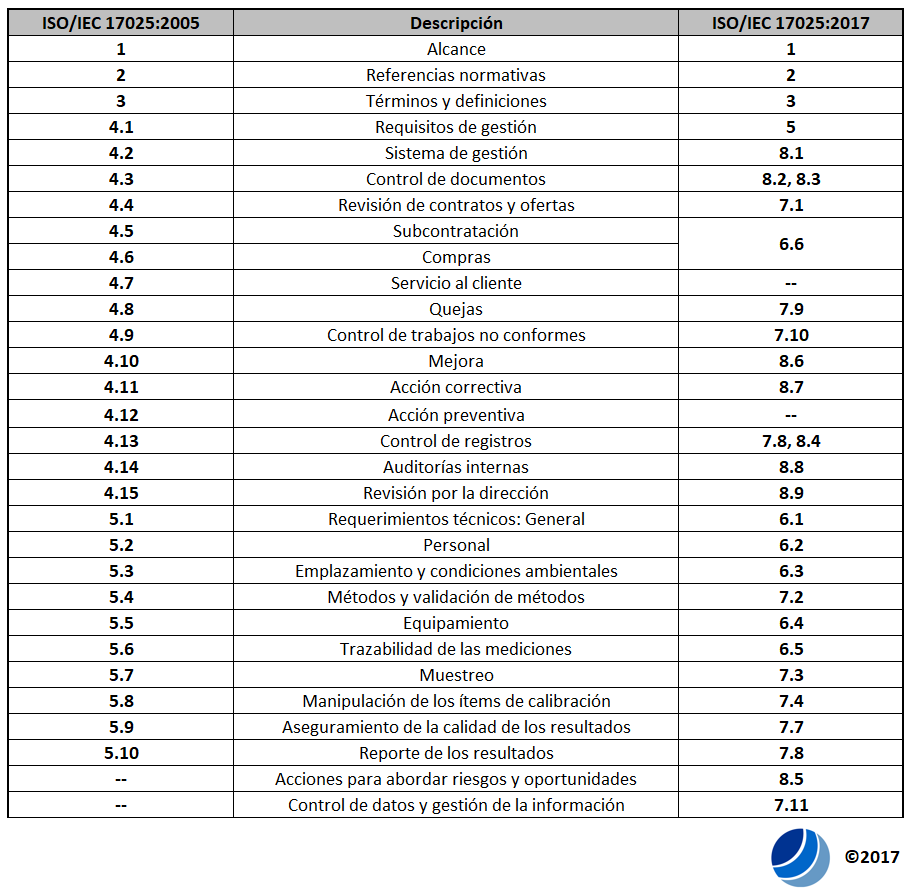
- El Punto 6 define los requerimientos de los recursos: el personal, el equipamiento, las condiciones ambientales, la trazabilidad metrológica y las compras y subcontrataciones se incluyen en este punto. Corresponde a gran parte del Punto 5 de la versión anterior y algo del Punto 4.
- El Punto 7 indica los requerimientos de los procesos: revisión de los contratos, métodos de muestreo, evaluación de la incertidumbre, expresión de los resultados, manipulación de los ítems de calibración, validación de los métodos. Comprende el resto del Punto 5 de la versión anterior y poco del Punto 4 para completarlo. Se agrega como requisito el control de los datos y la gestión de la información.
- El Punto 8, por último, detalla los requerimientos de gestión: control de documentos y registros, mejora, acciones correctivas, auditorías internas y revisión por la dirección. Gran parte del Punto 4 de la versión anterior se encuentra aquí. Como requisito nuevo y fundamental, se exige el abordaje de los riesgos y las oportunidades. En este Punto 8 aparece otra gran diferencia con la versión anterior, algo muy interesante. La Norma permite dos alternativas, en función de la actividad de nuestro laboratorio. Una Opción A y una opción B están disponibles. Para cumplimentar con la ISO/IEC 17025 nueva versión debemos:
- Opción A: Cumplir los requisitos de gestión indicados explícitamente (control de documentos y registros, mejora, acciones correctivas, auditorías internas y revisión por la dirección). Al igual que en la nueva versión de la ISO 9001 (ISO 9001:2015) desaparece el concepto de acción preventiva.
- Opción B: Contar con un sistema de gestión de la calidad existente bajo ISO 9001, lo que nos exceptúa de verificarlo en ISO/IEC 17025, ya que se se supone que con ISO 9001 ya se contemplan dichos requerimientos.
- El Anexo A brinda información sobre trazabilidad metrológica.
- El Anexo B lo hace con respecto a sistemas de gestión.
On November 29, 2017, the new version of ISO / IEC 17025 («General requirements for the competence of testing and calibration laboratories») was officially launched. We are, therefore, before the third edition of this standard: ISO / IEC 17025: 2017. There were many expectations about this launch, which was written in February 2015 and which was postponed in time on several occasions. And is not for less. We are talking about the standard par excellence for quality management in calibration and testing laboratories. It is the one with the highest international acceptance. It is aligned with ISO 9001, so with the appearance of its 2015 version it was expected that the latest revision of ISO / IEC 17025 would appear immediately. But it took almost three years before it finally happened.

This standard is aligned in some way with ISO 9001, so part of the novelties brought by the new ISO / IEC 17025 have to do with aspects that appeared in ISO 9001: 2015. For example, one of the most important aspects of ISO / IEC 17025: 2017 is the emergence of the concept of risk. The norm today demands the identification and approach of risks and opportunities. This implies a series of changes that directly and indirectly affect requirements that already existed in previous versions: impartiality, confidentiality, corrective actions, assurance of the validity of the results, etc. Some terms also disappear, such as preventive action. It has a greater focus on processes, and less documentary requirements.
Structure of the previous version ISO / IEC 17025: 2005
The previous version had 5 points and 2 annexes:
Point 1 provided the Scope.
Point 2 indicated the normative references, all the documents that were taken as a basis for the drafting of the Standard: ISO 17000 and VIM.
Point 3 referred to the technical definitions necessary for the understanding of the Standard, which were redirected to two documents: ISO / IEC 17000 and VIM.
Point 4 established the management requirements: the need for a quality management system, document control, customer service, continuous improvement, etc.
Item 5 was the one that differentiated this Standard from others in a noticeable way. It defined all the technical requirements that the laboratory should complete. The competence of the personnel, the adequate equipment, the validated methods of calibration and testing and the way of taking and expressing the results were the most important.
As additional information, the Standard contained two annexes:
Annex A with a comparative table between ISO / IEC 17025 and ISO 9001: 2000 (which lost validity with the revision of ISO 9001 in 2008 and was accentuated in 2015).
Annex B with a guide to establish applications in specific fields.
Structure of the new ISO / IEC 17025 version: 2017
The new version consists of 8 points and 2 annexes:
Point 1 provides the Scope and, except for some minor details and modifications in the wording (it was more synthetic), it is very similar to the previous version.
Point 2 on this occasion also makes reference to normative references. ISO 9000 is added as a reference and previous ones are maintained.
Point 3 here also establishes terms and definitions, based on the documents mentioned in Point 2, although for convenience it explicitly indicates the complete definitions of several commonly used terms. Complaints, interlaboratory comparison, method and validation are just some examples.
This is where the substantial differences in the structure of the Standard begin.
Point 4 talks about the general requirements: impartiality and confidentiality. Although these points are mentioned several times in the previous version, a complete section was dedicated to them here. These are extremely important points for a laboratory free of interests outside of its own technical activity.
Point 5 establishes the structural requirements. Here is defined how the laboratory should be organized and how it should interact with the environment: clients, stakeholders, legislation. It is almost identical to Point 4.1 of the previous version.
Point 6 defines the requirements of resources: personnel, equipment, environmental conditions, metrological traceability and purchases and subcontracts are included in this point. It corresponds to a large part of Point 5 of the previous version and something of Point 4.
Point 7 indicates the requirements of the processes: review of the contracts, sampling methods, uncertainty evaluation, expression of the results, manipulation of the calibration items, validation of the methods. It includes the rest of Point 5 of the previous version and little of Point 4 to complete it. It is added as a requirement the control of the data and the management of the[:]